The FT finished on Friday only about 50 points above its November low, the Dow's just hanging on above 7000.
Yesterday it dropped another 5% to a new low for this crisis. But given that the 2003 bottom (3300-ish ?) was caused by evaporating dot-com illusions, whereas this one's more down to various major structural unpleasantnesses, I'd have thought shares have a way to go - say to 2500-ish ?
It strikes me that someone like myself - on a smallish pension but with a chunk of savings in the bank - has only one chance to preserve any value. I need the FT100 to get down to 2500 as quickly as possible (at which point I get out of cash and into shares) before
Gordon's printing-presses render both pension and savings worthless.
Wednesday's meeting of the Monetary Policy Committee will be shown the letters and then King will be allowed to take the Bank into the unknown. Normally the nine members of the MPC discuss interest rates, but having cut them to just 1 per cent this month, they have almost reached the end of that road. Now, instead of debating the price of money, the MPC will concentrate on the amount of it.
Quantitative easing allows the Bank to buy gilt-edged securities or corporate bonds from City institutions or through the market. As the Bank will not itself borrow the £100bn or more necessary, it is in effect printing money.
"There will be blood" says Niall Ferguson :
“There will be blood, in the sense that a crisis of this magnitude is bound to increase political as well as economic [conflict]. It is bound to destabilize some countries. It will cause civil wars to break out, that have been dormant. It will topple governments that were moderate and bring in governments that are extreme. These things are pretty predictable. The question is whether the general destabilization, the return of, if you like, political risk, ultimately leads to something really big in the realm of geopolitics. That seems a less certain outcome. We've already talked about why China and the United States are in an embrace they don't dare end. If Russia is looking for trouble the way Mr. Putin seems to be, I still have some doubt as to whether it can really make this trouble, because of the weakness of the Russian economy. It's hard to imagine Russia invading Ukraine without weakening its economic plight. They're desperately trying to prevent the ruble from falling off a cliff. They're spending all their reserves to prop it up. It's hardly going to help if they do another Georgia.”
“I was more struck Putin's bluster than his potential to bite, when he spoke at Davos. But he made a really good point, which I keep coming back to. In his speech, he said crises like this will encourage governments to engage in foreign policy aggression. I don't think he was talking about himself, but he might have been. It's true, one of the things historically that we see, and also when we go back to 30s, but also to the depressions 1870s and 19980s, weak regimes will often resort to a more aggressive foreign policy, to try to bolster their position. It's legitimacy that you can gain without economic disparity – playing the nationalist card. I wouldn't be surprised to see some of that in the year ahead.
It's just that I don't see it producing anything comparable with 1914 or 1939. It's kind of hard to envisage a world war. Even when most pessimistic, I struggle to see how that would work, because the U.S., for all its difficulties in the financial world, is so overwhelmingly dominant in the military world.”
Nothing, to be honest, that thee or me couldn't speculate on. Everyone knows that you need "a grand theme to appeal to the masses" at such times. The question is, what will that be? I can't see the EU, or even Putin (at present) annexing the Ukraine. In the UK I think we'll see more reality TV shows as HMG desperately try to keep the circuses running.
But there will be political consequences nonetheless. I particularly admire the attempts of the 'Scottish Government' to raise political awareness (and boost Carlisle and Berwick supermarket sales) by
raising the price of alcohol. In today's Britain, a sober man will be an angry man.
The Economist
has noted, two years on, the Government's retreat (which I blogged
here) from the policy of engagement with (i.e. state funding of) the Muslim Council of Britain.
Now that system, and its unspoken compromises, lies in ruins. It was jettisoned in the autumn of 2006, when the government downgraded existing ties with the Muslim Council of Britain (in which movements close to the Muslim Brotherhood and the Islamists of Pakistan were strongly represented) and tried to find different interlocutors.
They've also noted that they've found no suitable replacement.
Nearly three years on, the government’s biggest problem is that it is struggling with two big questions at once. One is the set of problems described under the catch-all term of “cohesion”—narrowing the social, economic and cultural gap between Muslims (especially in some poor urban areas of northern Britain) and the rest of society. The second is countering the threat from groups preparing to commit violence in Britain or elsewhere in the name of Islam.
Alas, as I've pointed out
many a time, the govts attempts at 'cohesion' merely show modern British culture - or
lack thereof - in all its threadbare shame - not exactly an enticing prospect. This story will run and run.
The mother of Henry Webster
speaks out :
It was January 11, 2007, when Henry, then 15 and a ginger-haired star rugby player, popular with his class mates and with no history of being disciplined for poor behaviour, arrived at the tennis court at The Ridgeway School in Swindon to settle, "one on one", an argument with a fellow pupil. Only it was a baying mob and not a single opponent waiting for him.
What happened next, witnessed by more than 100 pupils – and even filmed by one on a mobile phone – was an ambush so vicious that, at the subsequent court case, the judge described it as a ''savage and sustained attack".
It was, said Judge Carol Hagen when she passed sentence on 13 boys and young men who set upon Henry, a ''miracle'' that Henry had survived.
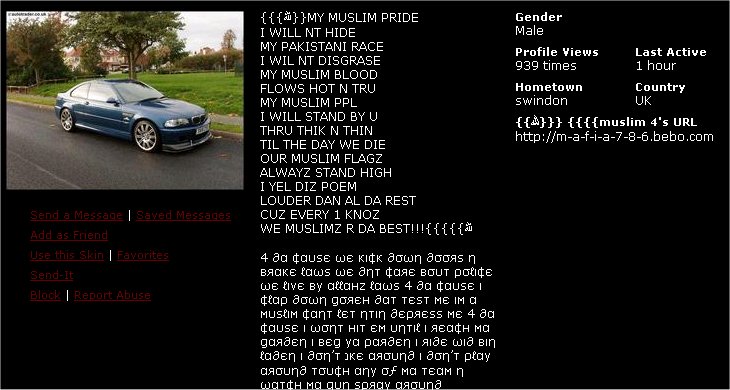
Though the 13 Asian teenagers and young men who attacked Henry – all members of a gang who called themselves the ''Asian Invaders'' – were given sentences of between eight months and eight years for grievous bodily harm and conspiracy to commit GBH, no independent inquiry into how Henry was brutally assaulted, while at school, in an attack that was described in court as ''something out of a Quentin Tarantino film".
During the trial, Judge Hagen was highly critical of the school, asking why there were no staff present in the tennis courts at the end of the school day, since it was known there had been trouble earlier in the day.
For the past 14 months Henry's mother has battled for a full inquiry and, after gaining support from the Government, has now won the right to a Serious Case Review on the attack.
The inquiry, which does not seek to apportion blame but to investigate what happened and evaluate what lessons can be learned, is expected to last four months and will, for the first time, lift the lid on alleged racial tensions within a school.
''I've fought hard to find out all the facts,'' said Mrs Webster, who is also suing The Ridgeway School for neglect. ''And it's been an excruciating wait.
"The school might say otherwise but the fact is that the attack on my son was a racial one. The school knew there were tensions – there have been numerous similar attacks before but nothing was ever done.
"Everything was swept under the carpet. Neither Henry or I am racist. But I feel my son was badly failed by a school that believes racism is only ever something that is carried out by white pupils."
It took a sustained campaign before the review was instigated by Mr Balls, the Secretary of State for Children, Schools and Families.
After a meeting with Mrs Webster he wrote to her saying that it was ''unacceptable that there has not been any full investigation of such a serious incident which left your son with permanent injuries".
Henry was repeatedly kicked, punched and battered before being beaten on the head with a claw hammer, fracturing his skull in three places and leaving him with permanent brain damage.
The Swindon local authority referred the case to their Local Safeguarding of Children Board, which has now sanctioned the review.
The headteacher of The Ridgeway School, Mr Steven Colledge, has said that he welcomes the investigation.
The case has highlighted the extent of racist incidents in our schools and, in particular, the reluctance on the part of some to treat attacks as racist when they are carried out by minority cultures.
Mrs Webster was not aware that, when those who carried out the crime came to court, it was up to the prosecution to cite the attack as racist.
Had that been proved, the sentences meted out – especially to Wasif Khan, 19, described in court as ''the hammer man'' and who was jailed for eight years for wielding the weapon that fractured Henry's skull – may well have been much stiffer.
What is particularly worrying, however, for parents in Swindon, is the light the case has shed on the number of racists attacks in the city's schools and how such incidents escalate.
Between November 2006 and November 2008 police dealt with 337 crimes – 137 of them violent incidents – at Swindon schools.
The highest number of those attacks, some 58, occurred at Churchfields school while 52 were recorded at Ridgeway school.
In the past 12 months, admittedly, perimeter fences and bans on mobile phones has helped the school reduce its number of violent crimes.
Henry, bleeding heavily from his head, was taken to hospital and, within 35 minutes, police had rounded up several of the gang members. It was Joe, Henry's younger brother, who telephoned his mother.
He had been standing at a bus stop when a passing pupil told him Henry had been beaten up. ''You can't imagine how it feels to see your son soaked in blood,'' Mrs Webster said, tears threatening.
''I just couldn't believe that no one from the school had called me to say there had been trouble earlier. All the pupils knew something was going on.
"When I was with Henry at the local hospital's accident and emergency unit one of Henry's friends telephoned me to say the same thing had happened to him some time before but he had managed to get away.
"All the children knew that these 'Asian invaders' were terrorising white pupils.''
For Mrs Webster the Serious Case Review will, she hopes, give some insight into how such a violent attack happened on the school premises.
''As far as I can see there was no control and no discipline,'' she says. ''Bullying and violence were rife when Henry was attacked and I want the school to admit that.''
Mr Colledge, the headteacher of The Ridgeway School, was unavailable for comment.